
How Long Does a Pellet Stove Igniter Last?
Summary
A Pellet Stove Igniter is the heart of any modern pellet appliance, converting wood pellets into cozy warmth. Learn about silicon nitride technology, real-world lifespan expectations (50,000+ cycles), troubleshooting failed igniters, and how to choose the right replacement for your stove, boiler, grill, or smoker.
A Pellet Stove Igniter is the heart of any modern pellet appliance, converting wood pellets into cozy warmth. Learn about silicon nitride technology, real-world lifespan expectations (50,000+ cycles), troubleshooting failed igniters, and how to choose the right replacement for your stove, boiler, grill, or smoker.
Quick Navigation
Click any section to jump
When winter arrives and temperatures drop, nothing provides comfort like a reliable pellet stove. At the core of every automatic-ignition pellet appliance lies a small but critical component: the Pellet Stove Igniter. This device glows red-hot within seconds, lighting the pellet fuel that keeps your home warm. Without a functioning igniter, even the best pellet stove becomes a manual-start chore. This comprehensive guide explores the technology behind modern igniters — particularly silicon nitride models — their remarkable lifespan (up to 50,000 cycles), and how to diagnose and replace a failing unit. Whether you own a pellet stove, boiler, grill, or smoker, understanding your Pellet Stove Igniter will save you time, money, and frustration during heating season. We'll also cover energy efficiency comparisons, installation pitfalls, and real-world performance data from laboratory and field tests.
1. What Is a Pellet Stove Igniter and How Does It Work
A Pellet Stove Igniter is an electric heating element that ignites wood pellets automatically when the stove calls for heat. Most modern igniters use silicon nitride (Si₃N₄) — a ceramic material that heats rapidly and withstands extreme temperatures. When your thermostat signals the stove, the igniter receives 120V or 230V power. Within 40 seconds, its surface reaches 1000°C (1832°F), hot enough to ignite the falling pellets. Once the flame is established and detected by a pressure switch or thermocouple, the igniter shuts off. This on-demand operation reduces energy consumption while providing convenience. Older stoves may use steel or nichrome igniters, but they degrade much faster. Premium igniters from manufacturers like Haining Torbo Ceramic Products Co.,LTD. use hot-pressed silicon nitride for exceptional durability. The ignition cycle typically lasts 2-5 minutes, after which the igniter rests until the next heating cycle. Some advanced models feature soft-start technology that gradually increases temperature to reduce thermal shock.
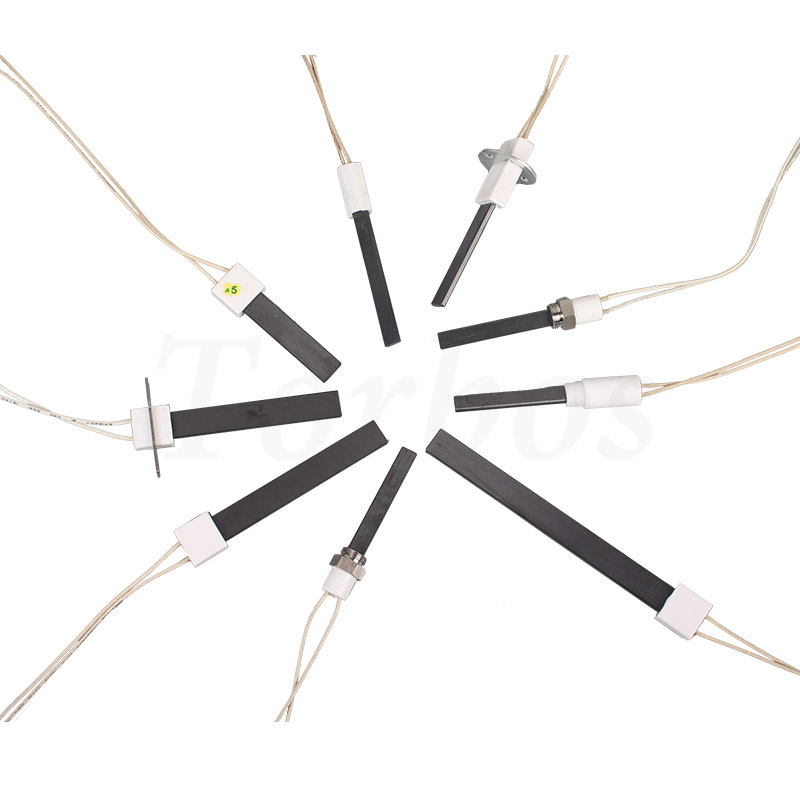
2. Silicon Nitride Technology: Why Material Matters
- Hot-pressed silicon nitride – Extremely dense, uniform grain structure. Resists cracking under thermal shock.
- Fast heat-up – Reaches 1000°C in just 40 seconds, minimizing pre-ignition delay.
- High sustained temperature – Maintains 1100-1200°C without performance degradation or aging.
- Oxidation and corrosion resistance – Withstands the acidic environment inside pellet stoves (from wood combustion).
- High strength and toughness – Survives vibration, mechanical shock, and repeated expansion/contraction cycles.
- Low thermal mass – Cools quickly after shutdown, reducing residual heat stress on surrounding components.
Silicon nitride has replaced older materials like molybdenum disilicide and steel because it lasts 10-20 times longer. A quality silicon nitride Pellet Stove Igniter can endure 50,000 3-minute on / 3-minute off test cycles without damage. This translates to roughly 10-15 years of normal home use, depending on how frequently your stove operates. Additionally, silicon nitride igniters are CE and RoHS certified, ensuring they meet European safety and environmental standards. When shopping for a replacement, always verify the igniter material — avoid generic "ceramic" rods that may be lower-grade alumina or mullite. The hot-pressing manufacturing process creates a material that is 99% dense, eliminating porosity that can lead to crack initiation. This is why Torbo's igniters consistently outperform budget alternatives in accelerated life testing.
3. Lifespan Expectations: 50,000 Cycles and Beyond
How long should a Pellet Stove Igniter last? Laboratory tests on hot-pressed silicon nitride igniters show no degradation after 50,000 rapid cycles (3 minutes on, 3 minutes off). In real-world conditions, where cycles are less frequent, you can expect 8-15 years of service. Factors that affect lifespan include:
| Factor | Impact on Lifespan | Mitigation Tip |
|---|---|---|
| Frequency of use | Daily heating (6+ cycles/day) reduces years but not total cycles | Choose high-cycle-rated igniter (50k+ cycles) |
| Power quality | Voltage spikes can damage the igniter | Use a surge protector on your stove circuit |
| Ash buildup | Insulates igniter, causing overheating | Clean burn pot and igniter chamber monthly |
| Moisture in pellets | Wet pellets require longer ignition, stressing igniter | Store pellets in dry conditions, test moisture <10% |
| Drafts in the firebox | Cold air can cool the igniter, prolonging on-time | Ensure door gaskets seal properly |
One of the most impressive features of premium igniters is their resistance to aging. Unlike steel igniters that lose power after 2-3 years, silicon nitride maintains consistent temperature output of 1100-1200°C throughout its life. This means your stove will start as quickly on year ten as it did on day one. Field studies from pellet stove manufacturers show that silicon nitride igniters have a failure rate of less than 1% over 10,000 cycles, compared to 15-20% for steel equivalents. For homeowners who run their stoves 6 months per year with 5 start cycles per day, a 50,000-cycle igniter would theoretically last over 15 years. In practice, most users replace them proactively after 8-10 years, keeping the old unit as a backup.
4. Signs Your Pellet Stove Igniter Is Failing
Recognizing early failure signs helps you replace the Pellet Stove Igniter before a cold night leaves you stranded. Watch for these symptoms:
- Longer ignition times – Instead of igniting within 1-2 minutes, the stove takes 3-5 minutes or more.
- No ignition at all – Pellets fill the burn pot but never catch fire. The stove may error out after several attempts.
- Visible damage – Cracks, chips, or melted portions on the ceramic rod.
- Weak glow – The igniter glows orange instead of bright white-yellow (optimal is >1000°C).
- Intermittent starting – Sometimes lights, other times not. Often caused by internal cracking that worsens with thermal expansion.
- Burning smell – An electrical odor during ignition may indicate insulation breakdown or wire damage.
- Blown fuse or tripped breaker – A shorted igniter can cause electrical protection devices to activate.
Before replacing the igniter, check the electrical connections, fuse, and control board. A failed thermocouple or pressure switch can also prevent ignition even if the igniter works. Use a multimeter to test continuity across the igniter terminals. A reading outside 10-50 ohms (depending on model) typically indicates failure.
5. How to Choose the Right Replacement Igniter
When selecting a replacement Pellet Stove Igniter, match these specifications to your original part:
- Voltage – Most stoves use 120V (North America) or 230V (Europe). Check your stove's manual or old igniter.
- Power (Watts) – Typically 200-900W. Higher wattage heats faster but draws more current. Common values: 300W, 450W, 600W.
- Physical dimensions – Length, diameter, and shape (straight or L-bend). Measure your existing igniter or look up the OEM part number.
- Holder material – Alumina ceramic holders are standard; some include stainless steel sheathing for extra durability.
- Lead wire length and insulation – Wires must withstand 450°C. UL-certified high-temperature wire (Teflon or fiberglass) is preferred.
- Certifications – CE and RoHS indicate compliance with safety and environmental standards. UL or CSA certification adds confidence for North American buyers.
- Warranty – Reputable manufacturers offer 1-3 year warranties on silicon nitride igniters.
Universal igniters exist but often require adapters or wiring modifications. For easiest replacement, buy an exact match to your stove brand and model. Torbo offers igniters compatible with most major pellet stove brands including Harman, PelletPro, Englander, Castle, Quadra-Fire, and US Stove. Always purchase from a trusted supplier — counterfeit igniters may use inferior silicon carbide or molybdenum that fails within months.
6. Installation and Maintenance Tips
Installing a new Pellet Stove Igniter is usually a DIY-friendly task for anyone comfortable with basic tools. Follow these steps carefully:
- Unplug the stove – Safety first. Disconnect power completely and allow the stove to cool for at least 30 minutes.
- Remove the burn pot and access panel – Consult your stove's manual for igniter access location (usually behind the firebox or below the burn pot).
- Disconnect the old igniter wires – Note wire colors or take a photo for reference. Use needle-nose pliers if connectors are tight.
- Remove the old igniter – Unscrew any retaining clips or brackets. Some igniters slide out; others require removing a cover plate.
- Clean the igniter chamber – Vacuum out ash and debris that could insulate the new igniter. Use a soft brush for stubborn deposits.
- Install the new igniter – Place it in the same orientation as the old one. Ensure it sits flush against its mounting bracket.
- Reconnect wires – Use high-temperature wire nuts or supplied connectors. Ensure tight, corrosion-free connections. Avoid leaving bare wire exposed.
- Test before full reassembly – Plug stove in, start ignition cycle, and watch for red glow within 60 seconds through the viewport.
- Reinstall all panels and the burn pot – Run a full ignition cycle to verify normal operation.
Preventive maintenance extends igniter life: clean the burn pot weekly, vacuum the igniter area monthly, and inspect the igniter for cracks at the start of each heating season. Never use steel tools to scrape the igniter — use a soft brush or compressed air. Also, check the igniter gasket (if equipped) for wear, as air leaks can cause localized overheating.
7. Comparing Silicon Nitride vs. Steel Igniters
| Characteristic | Silicon Nitride | Steel (Nichrome / Kanthal) |
|---|---|---|
| Heat-up time to 1000°C | 40 seconds | 90-120 seconds |
| Maximum temperature | 1200°C+ | 800-900°C |
| Typical lifespan (cycles) | 50,000+ | 3,000-5,000 |
| Typical lifespan (years) | 8-15 years | 2-4 years |
| Power consumption per start | Lower (faster cycle) | Higher (longer cycle) |
| Resistance to oxidation | Excellent | Poor (rusts and embrittles) |
| Shock resistance | Moderate (can crack if hit) | High (bends rather than cracks) |
| Cost (initial) | $$$ | $ |
While steel igniters are cheaper upfront, the total cost of ownership over 10 years favors silicon nitride. You would need to replace a steel igniter 3-5 times in the same period, plus endure more frequent ignition failures. Additionally, the faster heat-up of silicon nitride means less electricity consumed per start cycle — a small but measurable savings over years of use. For critical applications like pellet boilers that run continuously, the reliability advantage of silicon nitride is undeniable.
8. Energy Efficiency and Cost Savings
While a Pellet Stove Igniter might seem like a small component, its efficiency affects your overall energy bill. Silicon nitride igniters reach ignition temperature 2-3 times faster than steel equivalents, consuming less electricity per start. If your stove starts 5 times per day for 150 days per year (typical heating season), here's the comparison:
- Steel igniter (400W, 120 sec/start) – 400W × (120/3600)h = 13.3 Wh per start. Annual: 13.3 × 5 × 150 = 9,975 Wh (10 kWh).
- Silicon nitride igniter (400W, 40 sec/start) – 400W × (40/3600)h = 4.44 Wh per start. Annual: 4.44 × 5 × 150 = 3,330 Wh (3.33 kWh).
At $0.15/kWh, that's a saving of about $1 per year — modest, but the real savings come from reduced service calls and fewer replacements. A single technician visit to replace an igniter can cost $100-200 in labor. By choosing a long-life silicon nitride igniter, you avoid that expense for a decade or more. For pellet stove repair businesses, installing high-quality igniters also reduces warranty callbacks and improves customer satisfaction.
9. Common Installation Mistakes to Avoid
- Mismatched voltage – Installing a 230V igniter in a 120V stove (or vice versa) causes immediate failure or non-ignition.
- Over-tightening mounting screws – Can crack the ceramic holder or the igniter rod itself. Use gentle, even pressure.
- Pinched or damaged wires – Leads crushed by access panels can short out. Route wires carefully through designated channels.
- Wrong orientation – Some igniters have a specific top/bottom; installing upside down reduces pellet contact.
- Ignoring the gasket – If your stove uses a gasket around the igniter, replace it when installing a new igniter to prevent air leaks.
- Skipping the chamber cleaning – Ash buildup insulates the igniter, causing overheating and premature failure.
- Using non-high-temperature wire extensions – Standard wire insulation melts, creating a fire hazard.
If you're unsure about any step, consult your stove's service manual or hire a qualified technician. A small investment in professional installation can prevent costly damage to the stove's control board or wiring harness.
10. Frequently Asked Questions (FAQ)
Can I manually light my pellet stove if the igniter fails?▼
Yes, most pellet stoves have a manual ignition mode or allow you to light pellets with a propane torch or gel lighter while the auger feeds them. Follow your stove's manual for safe manual lighting procedures. However, this is only a temporary fix — replace the igniter as soon as possible. Prolonged manual lighting can create soot buildup and is less convenient.
Are silicon nitride igniters better than steel?▼
Absolutely. Silicon nitride heats 4x faster, lasts 10-20x longer, and maintains stable temperature over thousands of cycles. Steel igniters often fail within 2-3 years due to oxidation and embrittlement. The higher upfront cost of silicon nitride pays off quickly in reliability and fewer service interruptions.
Why does my igniter glow but pellets won't light?▼
Three common reasons: 1) Airflow problem — weak combustion blower means not enough oxygen. 2) Damp pellets — moisture content above 15% prevents ignition. 3) Igniter position — the igniter may have shifted and no longer contacts the pellet pile. Check and clean the burn pot, test a handful of pellets in a separate fire, and verify igniter location using the manufacturer's gap specification (usually 1/8" to 1/4" from pellet drop zone).
How often should I replace the pellet stove igniter preventively?▼
Quality silicon nitride igniters don't require preventive replacement. Instead, keep a spare on hand and replace only when failure occurs. If you use your stove daily (6+ cycles/day), consider replacing after 10 years as a proactive measure, but many exceed 15 years. Steel igniters should be replaced every 2-3 years preventively.
Can I use a 230V igniter on a 120V stove?▼
No — voltage must match exactly. A 230V igniter on 120V will not reach ignition temperature (only about 1/4 the heat output). Conversely, a 120V igniter on 230V will overheat and fail immediately, possibly causing a fire or melting the igniter holder. Always verify voltage before purchase — check the rating stamped on the old igniter or in the stove's manual.
What certifications should a quality pellet stove igniter have?▼
Look for CE (European Conformity) and RoHS (Restriction of Hazardous Substances). These indicate the igniter has passed safety, electromagnetic compatibility, and environmental standards. UL certification (for North America) or CSA (Canada) is also valuable but less common on foreign-made igniters. Additionally, ISO 9001 certification for the manufacturing facility indicates quality management systems.
What's the typical resistance (ohms) of a healthy igniter?▼
For a 120V, 300W igniter
Send Inquiry


X
We use cookies to offer you a better browsing experience, analyze site traffic and personalize content. By using this site, you agree to our use of cookies.
Privacy Policy